PEDGEN KMC KIT SELL
We accept bulk order
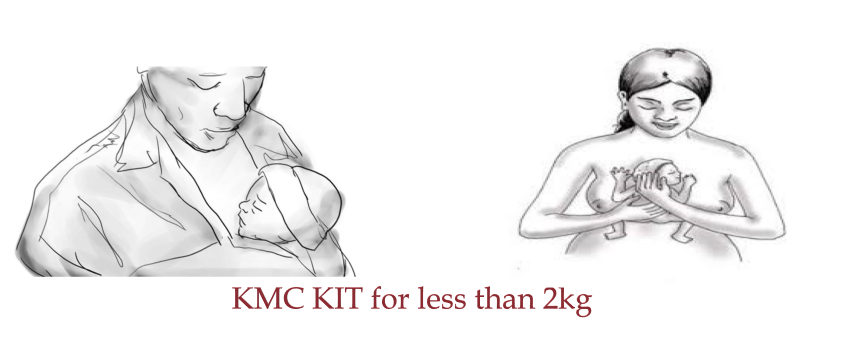
KMC KIT 1 (Below 2 KG)
- 2 sets of KMC Bag
- Socks, Gloves, Cap and Paladai
- PEDGEN KMC Monitoring Card
- Literature
- A Pen
- Soap

KMC KIT 2 (Above 2 KG)
- 1 set of KMC Bag
- Socks, Gloves, Cap and Paladai
- PEDGEN KMC Monitoring Card
- Literature
- A Pen
- Soap
KMC Kit Description
LBW and preterm birth are associated with high neonatal and infant mortality and morbidity. Kangaroo Mother Care (KMC) is a simple and powerful method used to promote the health and well-being of low birth weight and preterm infants. It encourages skin-to-skin contact between mother and baby, which improves survival and bonding.
- KMC is at least equivalent to incubator care.
- KMC facilitates breastfeeding and improves recovery in severe morbidity.
- KMC strengthens bonding between mother and baby.
- KMC improves neonatal care in both low and high-income countries.
- KMC is a modern and effective method even where advanced technology is available.
Clinical Evidence
Tele-KMC clinics using daily video mentoring achieved 100% KMC uptake and halved adverse outcomes (35.8% → 18.3%), demonstrating that telemedicine can effectively bridge the implementation gap in resource-limited remote SNCUs. Sustained KMC practice significantly reduced oxygen dependency (93.4% → 39.8%) and apnea incidence (30.3% → 13%), confirming that skin-to- skin contact is a low-cost, high-impact respiratory intervention for preterm and low birth weight neonates.
Reference: Agarwal N, Anand R, Jindal A, Baghel R, Kashyap R, Nag G, Bharti J, Singh G. Impact of Tele-Kangaroo Mother Care (KMC) Clinics on the Respiratory Outcomes of Newborns. Indian Journal of Pediatrics. 2025;92(10):1092–1097. https://doi.org/10.1007/s12098-025-05528-4
Clinical Evidence
Longer duration of KMC (8 hours/day vs 4 hours/day) produces significantly superior anthropometric outcomes in preterm and LBW neonates, with 8-hour KMC group achieving nearly 44% higher daily weight gain (15.07 gm/day vs 10.52 gm/day, p=0.001), along with significantly better head circumference and chest circumference increments across all gestational age subgroups. KMC duration has a dose-dependent positive effect on neonatal growth - particularly weight gain - making prolonged daily KMC a simple, cost-free, high-impact intervention that should be actively encouraged in all healthcare settings.
Reference: Surandran S, Nagendra K. Impact of duration of kangaroo mother care on growth in preterm and low birth weight neonates: a prospective cohort study. International Journal of Contemporary Pediatrics. 2023;10(5):680–684. https://dx.doi.org/10.18203/2349-3291.ijcp20231143
Clinical Evidence
Stepwise PDSA-cycle-driven quality improvement intervention dramatically increased KMC uptake in postnatal ward from 11.5% to 91% (p<0.001), with mean daily KMC duration rising more than fourfold from 1.9 hours to 8.1 hours. Sustained KMC practice significantly reduced cold stress (32% vs 19%, p=0.002) and hypoglycemia (26% vs 9%, p=0.001) during hospital stay, while post-discharge outcomes also improved markedly.
Reference: Mandal S, Sen S, Mandal RD, Patra KK, Madhwani KP. Improving the number of babies receiving Kangaroo mother care in post-natal ward among neonates weighting between 1.8 kg to 2.5 kg in a tertiary neonatal unit of eastern India. European Journal of Cardiovascular Medicine. 2023;13(2):1739–1746.
Clinical Evidence
Despite zero prior awareness of KMC among tribal mothers, all enrolled women accepted and practiced KMC after IEC intervention, with mothers, ANMs, and AWWs acknowledging benefits of improved warmth, weight gain, and breastfeeding. Key barriers identified were lack of family support, household workload, privacy concerns, and hot climate, while ANM/AWW willingness to train mothers emerged as the strongest facilitating factor.
Reference: Kulkarni R, Chauhan S, Rasaily R, Desai R, Tryambake V, Panhale M. Qualitative assessment of acceptability of Kangaroo Mother Care in a tribal block in Maharashtra, India. Perinatology. 2016;17(3):83–88.
TESTIMONIAL
Supporting low birth weight and preterm babies through innovative newborn care solutions.

Mother (Poonam) — Preterm Baby, Patna, Bihar
My baby was born very small and I was scared to hold him. The PEDGEN KMC kit gave me confidence to keep him close to my chest safely. Within two weeks his weight improved. I wore it for 8-10 hours daily and it was very comfortable.
Father (Piyush Singh) — LBW Baby, Patna, Bihar
The doctors suggested KMC for our baby. The PEDGEN kit made it easy for both me and my wife to take turns holding her skin-to-skin. The fabric was soft and breathable. We could see her becoming stronger every day. I would recommend this kit to every new parent.